

Module 1. Strategy, positioning and scale
Guiding question
What is your organisation for, what can it do that nobody else does, and what kind of bigger do you want to be?
Before the live session
Work through this module before the session (about 45 minutes) and bring your questions to the live session.
What we cover
- The current context: working when the policy space is polarised, and reaching audiences you never had to reach before.
- Political space: local, national, regional or European — each implies different governance, skills and strategy. Mapping who else already occupies yours.
- Scope: choosing policy questions rather than research interests; a few initiatives rather than many projects; the case for a single-issue or sectoral focus when you are small.
- Values: every think tank has an ideological position; evidence does not tell you what to do. Being explicit about yours helps with funders, recruitment and credibility.
- Research, communications, advocacy: which functions you deliver, which you want to deliver, and what each demands in skills, staff and funding. Most organisations are further from their stated position than they think.
- Scale is more than size: expanding the team, increasing reach, enhancing influence, building alliances or developing a network of associates are distinct choices with their own costs. In some sectors or countries, staying small is a valid strategic approach.
In this module
- Reading 1. Build a think tank: The Why? questions (about 15 minutes)
- Reading 2. Build a think tank: The What? questions (about 20 minutes)
- Reading 3. Setting up a think tank: a new model and a short strategy (about 5 minutes)
- Further reading
- Live session
- Task for the week
- Quiz
- Recording
Reading 1. Build a think tank: The Why? questions
Before deciding what an organisation does, it helps to be clear about why it exists. This chapter asks founders to examine their motivations, presents how six founders explain theirs, and discusses why think tanks seek to influence policy and what evidence can and cannot do in that process. Note how your organisation would answer the questions in the first section; you will draw on them for the positioning note.
From Build a think tank: A guide for policy entrepreneurs (On Think Tanks), chapter The Why? questions.
These questions will help you:
- Reflect on your motivations to set up a think tank.
- Learn from the motivations of other think tank founders.
- Understand what a think tank is and what its most common functions are.
Why do you want to set up a think tank?
One of the first questions you need to ask yourself is: Why do you want to set up a think tank?
Usually, when trying to answer this question, people describe a specific policy or political, economic or social situation that they want to change or even a new direction they want their country (or the world, in some cases) to take. This motivation is fundamental in determining why we want to set up a think tank – it will help address what the think tank will work on. But we should also take a moment to reflect on deeper questions: Is a think tank the best way to achieve this? Do you have any other reasons for setting up a think tank? In practice, there are many reasons and motivations for wanting to set up a think tank. They range from ideal and high-minded to more practical, mundane and selfish reasons.
You may wish to set up a think tank simply to raise your personal profile and get into politics in the future, and you think that a think tank is a better vehicle than a political publication, a consultancy or academia. You might be a university-based researcher who wants to start a think tank to earn a decent living as a researcher-cum-consultant, or you might want to be seen as an authoritative expert and gain public recognition in your field. The motivations for wanting to set up a think tank are diverse and reflecting on them will help you clarify if there is something else that you seek. Understanding your motivations for setting up a think tank will also help you figure out what kind of think tank you wish to create, what activities it will undertake, who will work in it, and more. Here is a list of helpful questions to ask yourself:
- What problem or problems do you want to address? Is it personal or professional? Does it relate to the political, economic or social context in your community, country or internationally?
- What do you want to achieve?
- Do you think that evidence-informed arguments are absolutely necessary to achieve these objectives?
- Can you achieve it through alternative means? (e.g. academia, advocacy, or with an existing organisation)
- Why is a think tank the best means to achieve it?
You may think that a think tank is better than an academic research department at addressing policy challenges head-on. This is true. Think tanks are commonly policy-focused, whereas the incentives within academia tend to be in the opposite direction. But a regular op-ed in a national broadsheet might have the same impact in the short term, and your university may be well placed to help you with that. You may also think that it will be easier to raise funding for your research through a think tank. This is also true. Think tanks tend to be charities and tend to attract the attention of political and development philanthropists. But a well-run consultancy may be able to raise enough overhead from projects to fund its own independent research.
Throughout this guide, we will be addressing these and other questions. Reflecting on them early on will make the whole process easier for you. The guide also addresses more practical and mundane issues, such as different business models or how to assemble your team. Boxes 4 – 9 present a collection of the motivations of several think tank founders:
Box 4. Changing the system. Orazio Belletini and Grupo Faro – Ecuador
Orazio Belletini is a co-founder and former executive director of Grupo Faro (Ecuador). Read the full interview here.
‘After working several years in the private sector, I decided to start a new phase of my professional life by working in a development NGO. There I learned to appreciate the contribution that civil society organisations (CSOs) make by generating ideas and creating opportunities for the most vulnerable groups of society. This experience also helped me recognise that the work of CSOs usually focuses on specific groups rather than on changing the system that allows the appearance of problems such as social exclusion and environmental degradation.
I decided then to promote the creation of an organisation that would focus on delivering innovative solutions for social problems. My idea was to create an organisation that promotes citizen participation and encourages public-private collaboration to change the rules of the game; an organisation that, as described by Ashoka (a network of social entrepreneurs I belong to), does not just teach a (wo)man to fish but reinvents the fishing industry. I became convinced that one of the best way to achieve this goal was by influencing public policy.’
Box 5. Combining the skills of likeminded people. Simonida Kacarska and the European Policy Institute – Macedonia
Simonida Kacarska, is one of the founders and the current director of the European Policy Institute (Macedonia). Read the full interview here.
‘In 2011, with several likeminded individuals with whom we shared the experiences of working on the EU accession of Macedonia, we founded a civil society organisation that grew into one of the leading think tanks in the country and in the region.
At the time of its founding, I was completing my PhD and was looking of a way to professionally combine the different skills and competences that I have gained both over my education and previous working experience. For example, I have insight from engaging with political reforms in societies that undergo transformations as a civil servant, researcher, and lecturer. The think tank position was such an opportunity.’
Box 6. Streamlining good ideas to the public sector. Nicolás Ducote and CIPPEC – Argentina
Nicolás Ducote is a co-founder and former executive director and general director of CIPPEC (Argentina). Read the full interview here.
‘I was convinced that in Argentina there were no institutions that were strongly and perseveringly dedicated to taking the best ideas in public policy and pushing them towards the political process. I was very interested in putting together people whom I was approaching, who had an interest in causes such as education or health, and who did not have a vehicle to take their ideas to the world of public policy. And so, together with my associates and friends I decided to create an institution that would support entrepreneurs who wanted to change the Argentinean reality and who worried about what was important: that the things they proposed got done.
For them to be able to accomplish that, they would be free from some administrative tasks in the institution; we told them, ‘come work at CIPPEC and we will help you get funding, we’ll take care of communications, administrative issues, etc.; you just do the best you can to have impact, to put together a good team and to insert your area of knowledge into others, because most problems are interdisciplinary’. That is how we began with the idea that this would serve as a platform for public or social entrepreneurs, to integrate public policies, and to do it with a very strong focus on implementation; not just producing papers, but having an impact on the decision-making process.’
Box 7. Putting issues on the table. Gilles Yabi and Wathi – Senegal
Gilles Yabi is the founder of the West Africa Citizen Think Tank (WATHI) in Senegal. Read the full interview here.
(On the decision to set up a think tank) ‘It is actually more about citizen engagement and a certain idea of what is important in one’s life than about my career. I thought there was no reason to wait for retirement age to start something I am excited about and to take risks. I first had the idea when I was a PhD student in France. I wanted to do something useful and original in the region, and a think tank in West Africa can still be original. The concept is new even to many highly educated people here, especially in the Francophone countries. What think tanks exist are largely concentrated in [Anglophone] Ghana and Nigeria.’ (On the motivation for setting up WATHI) ‘The states and the societies in the region have to change. The systems have to change: political, economic, and educational systems, as well as systems of values. I’m setting up a think tank with a large group of friends and contacts because we need to put some issues on the table, those which we believe are crucial for the future of West Africa in particular. WATHI is not a typical think tank built on in-house experts in specific fields. The goal is to create a participative think tank, one whose objective is not to produce big sophisticated reports but rather to act as a filter for available knowledge that is useful and share it as widely as possible to stimulate debate and reforms.’
Box 8. Generating research to understand current challenges. Gustav Brauckmeyer and Equilibrium CenDE – Peru
Gustav Brauckmeyer is the executive director of Equilibroum CenDE. Read the full interview here.
‘Equilibrium CenDE was born out of the need to better understand both the Venezuelan migratory phenomenon and the challenge it presents for the region, as well as the challenges that arise in Venezuela in areas such as education, employment, entrepreneurship and civil society development. In general, there was a clear need to generate more research and data to understand these challenges, and that data could drive the debate and the creation of innovative solutions to face them.’
Box 9. Connecting academia with policy. Seyed Emamiam and GPTT – Iran
Seyed Sadegh Emamiam is the founder and director of the Governance and Policy Think Tank (GPTT) in Iran. Read the full interview here.
‘As a postdoc researcher, I spent more than a year in London to study think tanks there. I was involved with a few think tanks in London and I was very inspired by their work. They were not the same institutionally, they were not necessarily alike, but their functions were very important, and I was inspired by the idea. When I moved to Tehran in 2015, I found a necessity to expand our research institution towards the policy area, because it was a very active part of academia and was somewhat successful, but there was a disconnect between academia and policy. I found that we needed a bridge between academia and policymaking, and that was the main idea behind the GPTT.’
As you can see from the experiences of these founders, the reasons for establishing a think tank may vary in the way they are framed, but in general they all wanted to produce good quality research – with teams of like-minded people worried about society’s challenges – to provide good ideas to policymakers. In other words, they wanted to influence policies.
Why do think tanks aim to influence policy?
Any discussion about think tanks needs to consider the field of evidence-informed policy. The prominence and spread of evidence-based discourse (which we refer to as informed policy) saw a rise in popularity with New Labour in Britain in the late 1990s and has spread to multiple sectors across the developing world, first aided by the policies of the UK Department for International Development (DFID) and later adopted by other prominent public and private international development agencies (Du Toit, 2012). Informing policymaking with research-based evidence is important and commendable, but its underlying assumptions need to be considered (and dealt with). Du Toit (2012) critiques the evidence-based policy model and argues that it erroneously understands policymaking as a process that should only concern itself with instrumental rationality (what works), positing that policy decisions should be based on impartial, objective and rational assessment of available evidence (the right kind, or best kind) and devoid of any values. It thus assumes that there is a right way and a wrong way to do something. But social science, and science more broadly, is not a neutral field. There are values involved in what evidence is produced and how, as well as how findings are communicated and to whom. Evidence-informed policy is a political terrain (Du Toit, 2012).
Academic studies of evidence-based policymaking suggest that policymaking can never be ‹evidence-based’; rather, policy can only be strongly evidence-informed if its advocates act effectively (Cairney 2016). Du Toit (2012) goes on to argue that while research findings are important, ‘we need to look at how policy narratives work with it; how it is used; and how it is alternately marginalised or seized on, ignored or imbued with significance’. This is a key role that think tanks can play: the combination of providing evidence and developing a coherent and adequate analysis of social processes.
The development of public policies is an area that by its nature requires the mobilisation of a variety of knowledge types, and the purpose of promoting this approach is not to reduce the policy process to a scientific problem-solving exercise. Recognition of these realities has led to a language shift towards the use of ‘evidence-informed’ (instead of ‘evidence-based’) when referring to policymaking.
Generally, the growing literature agrees that when it comes to influencing policy, scientific evidence:
- Will never be more than one of the inputs to the policy process – alongside ethical, fiscal, political, and other considerations, and therefore it is not the only source of information that a policy analyst needs to consider.
- Does not necessarily need to be derived from experimental methods to be considered a valid input for policymaking.
- Always carries a certain degree of uncertainty, whether in the conclusions of a study or in how to interpret results and adapt them to a different context.
Box 10. The knowledge translation toolkit
Bridging the know–do gap: A resource for researchers (Bennett, and Jessani, 2011), presents an overview of knowledge translation and how to bridge the ‘know–do’ gap between research, policy, practice and people. It also provides resources to encourage and enable evidence-informed decision-making.
Box 11. The role of think tanks in developing societies
Gurucharan G, director at the Public Affairs Centre (PAC) in India. Read the full interview here. ‘
Think tanks have an important role in any society, but this role is sharply enhanced in developing societies. In essence, a think tank must do three things at all times:
- Speak truth to power,
- Give voice to the community to hold the state to account
- Help improve the quality of governance for better development outcomes.
But why do we do this? Why do think tanks and policy research centres embark on this road? Ruth Levine has asked herself the same question and resolved that ‘no field can be sustained and advanced unless it confronts and articulates its moral core’ (Levine, 2018). So, what are some of the moral ideas behind evidence-informed policymaking and the missions of think tanks?
- The pursuit of truth: research is ultimately about trying to discover the truth about what is being studied. The truths uncovered might be specific or even small, but they aspire to be truthful (Levine, 2018).
- Distributive justice: think tanks aim for their research and recommendations to ensure the fair allocation of resources (Levine, 2018). There are always trade-offs to be made, and the research that think tanks do helps untangle them. Organisations might have different definitions of what fair distribution is, but they still strive towards their individual visions.
- Visibility and the representation of different voices: as Levine (2018) states, ‘if it weren’t for efforts to collect the same type of information from each and every individual – or at least a representative sample of each and every type of individual – what would we know? We would only know about the lives, livelihoods, and opinions of the people who have the greatest access to the public square’. Thus, the research that think tanks carry out, in a way, ensures that many voices are heard in the debate and provides a deeper understanding of the realities of different groups. Examples of these groups range from manufacturers and their employees, who stand to lose from a new trade deal, to subsistence farmers in remote rural areas, who are affected by climate change. By studying groups like these, think tanks can help ensure that the public debate represents their specific needs.
Reading 2. Build a think tank: The What? questions
This chapter moves from motivation to what the organisation will do. It covers how context shapes a think tank and the questions to ask when analysing yours: vision, mission and values; how to choose the issues to work on; and the levels at which a think tank can seek influence. You do not need to answer every context question; focus on the ones that matter for your organisation and bring them to the live session.
From Build a think tank: A guide for policy entrepreneurs (On Think Tanks), chapter The What? questions.
The section on business models is in Session 3.
These questions will help you:
- Understand the context your think tank will be born into and how this context will affect your think tank’s activities, research areas, communications, access to funding and organisational set-up (among other aspects).
- Understand the concept of mission, vision and values, and reflect on what these will be for your organisation.
- Reflect on the issues that your think tank will focus on.
- Reflect on the impact it aims to achieve.
- Clarify your organisation’s business model: the way in which your organisation will go about achieving its goals.
What will your think tank do?
In this chapter we discuss several questions that will help you define what exactly your think tank will do. As we have seen, think tanks can fulfil many functions, so you need to be clear on what your goals are. We recommend that as soon as you start working on the goals of your think tank, you spend time analysing your context. Local and global contexts will condition what your think tank can do, and understanding these will help you identify different strategies.
What is the context?
Think tanks are a product of, and intertwined with, their context. An organisation’s research choices, functions and even its impact are a response to its context. The context will frame and influence the research agenda, the communication strategies, and even the ways of engaging with the think tank’s key audiences. Think, for example, how the global context of the COVID-19 pandemic changed almost every mode of engagement and shifted the priorities of both governments and funders. Context will affect an organisation at every level, in all its functions and characteristics. It is therefore fundamental to assess it early on so you can:
- Identify if your ideas (about the challenges or opportunities you want to address) are relevant.
- Assess your real capacity to have influence.
- Position your efforts in the context of relevant current trends (evidence needs, policy gaps, donor priorities, etc.).
- Map out ‘the competition’ and assess who you might be able to partner with and who is likely to challenge your project.
- Analyse local, national and international spaces for action.
- Understand what roles a new think tank could possibly play.
- Decide what type of think tank you should create and how it should operate.
For example, in Bangladesh and Vietnam, political competition affects how think tanks relate to political parties, just as deciding whether to affiliate with a party or remain independent affects their effectiveness. (Brown, 2015). In Vietnam, think tanks cannot be completely independent from the government; they need a sponsor to help them achieve their objectives. This is similar to the situation in China, where think tanks are deeply intertwined with the government and the Party and cannot function in absolute independence. In the United States, on the other hand, think tanks need to engage with philanthropists and the private sector to secure funding because financial separation from the government is considered essential.
Basically, all think tanks are embedded in a context that frames their work. No matter the sort of organisation that you aim to create, you will be acting and functioning within a system, and therefore you need to be realistic. You will not be able to change the whole system, but you may be able to shape parts of it.
Thus, when analysing your context, you should also consider the future. Take the time to think about what future you imagine for your think tank: what landscape do you imagine five years down the line? This will help you reflect up front on what could go wrong. You should start considering the different risks you may face and how you could address them. There are also the policymaking and knowledge regimes that need to be accounted for. Knowledge regimes are ‘the organisational and institutional machinery that generates data, research, policy recommendations and other ideas that influence public debate and policy-making’ (Campbell and Pedersen 2014). To determine the local knowledge regime, you need to understand the policymaking regime (how policies are developed), the economy, the politics, and the social and cultural characteristics of a country – as these all influence the market of ideas and how research is produced and used. To understand how knowledge is produced and used in politics and policymaking, all of these variables (and their importance in a context) need to be accounted for. But how does the policymaking regime affect think tanks? Think about how, for example, Germany has a strong tradition of using research to inform policymaking, and its citizens and policymakers value the role of knowledge in policymaking. On the contrary, in Uruguay, politics trump technical reasoning; while in Chile, knowledge plays a vital role and creates bonds between political parties and interest groups (Garcé et al., 2018).
Box 12. The importance of local contexts
Dr Asep Suryadhadi, executive director of SMERU (Indonesia) discusses the importance of understanding the context when establishing a new think tank. Read the full interview here.
One thing that I have learnt is that context matters a lot. SMERU was established when Indonesia was in a transition from an authoritarian governance, where the government can get away with any policy they make, to a democratic governance, where every government policy is openly questioned and debated. This means now that the government needs evidence as the basis of any policy they make. On theother hand, there were not many of organizations capable of supplying evidence for policy. With this background of increasing demand and lack of supply of evidence, SMERU was able to capitalize the situation and develop itself into an established policy research institution in the country. So it is very important to understand your context. We cannot just copy successful think tanks in other countries as a model because it may not work in our country. This is not to say that we should not learn from other organizations as certainly there are useful lessons that other organizations can provide. However, by understanding our context, we will be able to set reasonable objectives that we want to achieve as well as determine how we can operate effectively and efficiently.
Box 13. Changing context
Chukwuka Onyekwena, executive director of the Centre for the Study of the Economies of Africa – CSEA (Nigeria). Listen the full interview here.
In general, the internal policies that I met in the past years was one where the demand for evidence was quite weak. Over the years, the demand was increasing gradually within the policy space. Think tanks have tried to really push to stimulate the demand for evidence. We thought that Think Tank initiatives which provided flexible funding allowed Think Tanks to emerge within Nigeria (…) As the availability of flexible fundings have been declining, now Think Tanks are struggling. The ability to stimulates evidence is now being unlimited. But that is also changing recently due to COVID. COVID is a shock. People from the policy space needed knowledge to explain what is going on, the impact, what strategy should we use to solve this challenge that is quite rare. Knowledge produced by Think Tanks became increasingly involved in providing adequate advice or recommendation on what to do. So COVID-19 arrived and increased the demand for knowledge and Think Tank has benefitted for that (…) Shocks tend to change the way we do things. For example, financial crisis was a big shock and a lot of accounting principles changed. COVID will change how policy actors view things, how they look at the future and how they prepare for such shocks. Think Tanks have the opportunity to be at the forefront of these kind of conversations. So, it will really trigger higher demand for evidence.
But how do you make sense of your context? What factors should you consider? In their publication Linking think tank performance, decisions, and context, Results for Development (2014) devised a framework for thinking about context as it relates to think tanks and their decisions. The framework describes different levels and factors that explain how think tanks make decisions based on their context. Ordoñez and Echt (2016a) have provided a summary of the framework, shown here in Figure 1, to help organisations reflect on their environments. The framework differentiates between exogenous, endogenous or mixed factors, based on the level of control that an organisation can exert.
- Exogenous factors: are ‘factors that are determined by forces outside of the think tank’s sphere of influence and that impact the think tank’s ability to achieve its goals’ (Brown et al, 2014). For example, the number and strength of political parties, an authoritarian government, and turnover in key government positions, among many others, are all exogenous contextual factors that will affect what a think tank can do (Brown, 2015).
- Endogenous factors: are internal to the think tank and therefore under the control of the organisation, even though they are still influenced by the context. For example, hiring top-level staff is something that is largely under the control of the think tank but is influenced by the context: availability of adequately trained and experienced individuals, labour laws, the location of the think tank (capital or smaller city), and so on.
- Mixed factors: include circumstances in which context is partly a function of a think tank’s strategic choice and partly a function of variables outside of its influence.
But think tanks do not just passively accept their context: they are a product of their context, but they also seek to change it. They create strategies to respond to it; they use their communication, research, and policy engagement tools to address their contextual factors and react to them (Tolmie, 2015).
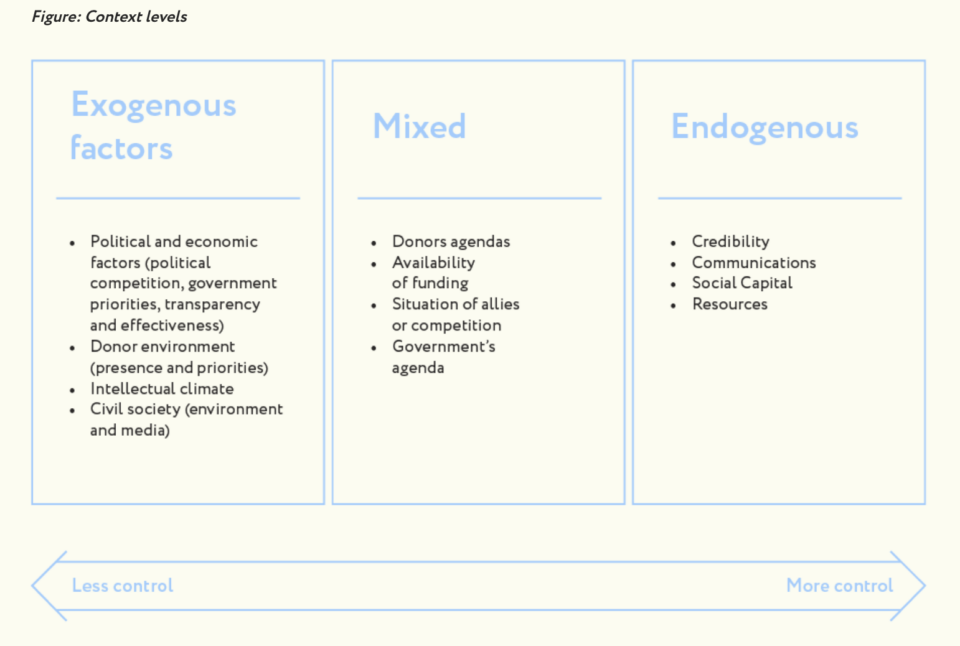
Source: Developed by Ordoñez and Echt (2016b) based on factors proposed by Results for Development (2014) and adapted by the authors of the Build a think tank guide.
Analysing your context: Key questions to reflect on
It is important to reflect on these contextual factors while thinking about the organisation you aim to create. Remember to focus on the aspects that help explain the situation that the think tank will be born into, and the aspects it will try to address. To do this effectively, you will need to be selective of the dimensions that you include in your analysis (Ordoñez and Echt, 2016a) and reflect on what the answers imply for the work that you intend to do, including how you will conduct research and communicate your findings. Here are some questions that can help you analyse your context (building on Ordoñez and Echt, 2016a; Results for Development, 2014; and Mendizabal, 2015):
Political context
- What are the characteristics of the political system in which you are involved? How does the political system react to independent thinking? How do actors react to the type of work you aim to produce?
- What are the main changes occurring in the political, social or economic systems? Are there any major developments or trends taking place? (e.g. democratisation, regionalisation, changes in economic policies, migrations, etc.)
- Are there any relevant policy or political milestones expected in the short or middle term? Are elections coming up? Is there a 5- or 10-year development plan in place? Is a new constitution or trade agreement being drafted?
- What actors would you need to engage with? Who is most relevant at the local, national and/or international level?
Evidence needs and access to information
- What is the state of the information on the topic you are choosing? What kind of information is available? Would we be able to carry out the necessary research to address any knowledge gaps?
- What contacts are available to you to access data or assess evidence needs?
- What are the interests, worries and capacities of public agencies regarding the use of research in policymaking? What are the needs of government institutions in terms of research? What are their capacities to generate, demand and use research? How can you start a discussion with them?
Funding
- What are the priorities, strategies and objectives of funders? Who supports the issues you are interested in? Who can you approach?
- What are the international trends in academia or policy? How will you relate to them to make your work more fundable?
- Are there any national, regional and global sources of public and private funding that you may be able to benefit from? What conditions are attached to them?
Intellectual climate
- What is the intellectual climate like? How is science valued? Is it considered valuable for policymaking? How do intellectual debates take place? Is it the same for all policy issues, or do some have bigger and more active intellectual communities?
- What will your relationship with other intellectually relevant actors (such as academics, journalists, opinion leaders, experts in your field and others) be like?
Will there be competition, debate or will you complement each other? How can you work together if necessary?
Civil Society
- What is the role of the media? Is it free? Is it overtly partisan?
- What other players foster the dissemination and use of evidence? Are there any academic communities with an active role in policymaking? Who are they? Who has more credibility? Why?
- Is there a demand for evidence from civil society organisations? What type of evidence do they prefer? Is civil society familiar with the evidence-informed approach that think tanks promote? What is their stance on it?
- Is there demand for evidence from social movements and other grassroots organisations? What type of evidence do they prefer? Are they familiar with the evidence-informed approach that think tanks promote? What is their stance on it?
- What is in the agenda of other research centres, universities and think tanks?
Regulatory regimes
- What are the regulatory frameworks that affect think tanks and research organisations? How do they enable or limit their ability to mobilise resources, human or financial? How do they enable or limit their ability to influence policy and practice?
- How will labour legislation affect your organisation? Does it permit flexible work contracts? Will you be able to hire globally?
- What is the tax legislation like? (Think not only in terms of how it affects the organisation but also potential donors). Does it encourage or discourage philanthropists to support research? Does it limit the activities think tanks may undertake (for instance, to maintain tax exemptions)?
- How does the exchange rate affect you? (crucial to consider if you have foreign funders)
- How does civil society legislation more broadly affect think tanks?
Other practical issues
- Is internet access widespread and reliable?
- Will you have access to online databases, academic journals, communities of practice, etc.?
- Will you be based in a large or a small city? Will it be in the capital or in another part of the country? How will this affect your access to policymakers, the media or other relevant actors? The definition of your location will be influenced by your goals and your desired level of influence.
- What is transport like within the city or to other cities? Will traffic affect the types of activities you wish to organise? For example, you might not be able to organise too many events if traffic limits mobility in the city.
- How does the education policy affect think tanks? Is critical thinking a value? Are research methods and writing well taught? These factors will affect the quality and quantity of researchers available to work with you.
What do you want to achieve by setting up a think tank?
Once you are firmly situated within your context and have a firm sense of how it will affect your future organisation, you should ask yourself ‘what would you like your think tank to achieve?’ To answer this, we recommend you reflect on the vision and the mission of your organisation, which are framed by your values (Mendizabal, 2013b; 2016).
Vision
The vision is your dream, the ideal world, the big picture of what you would like the think tank to achieve. It is not something that will be achieved in the short term. It should be visionary but at the same time realistic. Here are some examples:
‘Our vision is a world in which government, politics, business, civil society and the daily lives of people are free of corruption.’ Transparency International, Germany.
‘We envision a world of democratic freedoms and fair and sustainable development through European integration and international cooperation.’ Istituto Affari Internazionali, Italy.
Mission
The mission is the organisation’s purpose; it is what the think tank will do to contribute to the achievement of the vision. A good mission need not be lengthy. On the contrary, a short, powerful and clear mission is preferred. For example:
‘EPI’s mission is, through high-quality research and proposals on European policy, to provide a sound base for debate and solutions, targeting decision-makers and the wider public’ European Policy Institute, Macedonia. ‘Centre for London is the capital’s dedicated think tank. Our mission is to develop new solutions to London’s critical challenges and advocate for a fair and prosperous global city’ Centre for London, UK.
‘Using our knowledge, networks, funding and skills, we work hard to see new opportunities and challenges; spark creative answers from many sources; shape brilliant ideas into practical solutions; and then shift whole systems in a new direction’ Nesta, UK.
‘Our mission is to produce knowledge, propose initiatives, develop practices and support processes to contribute to the construction of a stable and lasting peace in Colombia’ Fundación Ideas para la Paz, Colombia.
‘To be recognised as an innovative institution that is committed to Brazil’s development, the formation of an academic elite, and the generation of public goods in social and related areas, guaranteeing our financial sustainability through the provision of high-quality services and high ethical standards’ Fundação Getúlio Vargas, Brazil.
Values
The values are the guiding principles and the foundation on top of which all actions rest, whether formally identified or not. They are beliefs about what is important, and the way to act. No individual or organisation is without values. Even independence, neutrality, and being led by data are values in themselves:
‘Everyone has them [values]. And every time that a think tank recommends a course of action it is making use of values: evidence does not tell us what to do. It informs and is the basis of our analysis to recommend courses of action’ Mendizabal, 2016. It is helpful to identify your own values in the early stages. They do not need to be specific to the point of limiting your actions, but should offer a sense of where your organisation might fall in the political spectrum. These may be rather simple (e.g. all for liberalisation) or more complex (e.g. liberal on social issues but more conservative politically and moderate on the economy) (Mendizabal, 2016).
Through our work with think tanks and policy research organisations, we have found that organisations tend to publicly frame their values not in terms of where they stand on the political spectrum, but rather by focusing on how they undertake their work. What values will underpin the way you work? Here are some examples to help you understand this: ‘Independence: The independence of our thinking, as much as its rigour and creativity, is what makes it influential. Inclusivity and diversity: We ground our analysis and solutions in an inclusive approach. We bring diverse voices to the table to find common solutions to shared problems. We ensure our research and outputs are widely accessible, so people can develop their own voice in international affairs. Collaboration: Collaboration is a core competence for our staff. It inspires our relationships with associates, partners, supporters and members and helps us develop global networks to find positive, durable solutions to policy challenges’ Chatham House, UK.
‘What we stand for: Independence. Excellence, Relevance and Innovation. Cross-cutting and Long-term Solutions. Multi-constituency and Inclusive. Partnership and Outreach’ European Policy Centre, Belgium.
‘The values that define CIDOB’s work are: The desire to act as a public good through the provision of international knowledge. Excellence, through the rigour, quality and independence of our analysis. Innovation in the approach to studying international relations. Visibility, via new research formats and media presence. The promotion of the good management and economic health of the institution and the proactive search for new projects’ CIBOD, Spain. You do not need to put your vision, mission, and values in writing – certainly not laminated. But working on them is highly recommended as they will certainly frame the work that you do. Also, having a clear mission will make planning a strategy easier. It will make your organisation more attractive to the like-minded individuals you want to work with, and it will draw attention and support from funders interested in the same issues (Mendizabal, 2016).
Box 14. What does the ‘About us’ section usually convey?
The ‘About us’ section of a website is an opportunity to showcase your organisation. What gets included, and also what gets left out, signals to readers (be they funders, academics, policymakers, activists, or the general public) who you are, what is important to you, and what they should expect from you.
We have found the best ‘About us’ sections include: who the organisation is (organisational structure, affiliations etc.), what the organisation does (main issues, functions), how it does it (key expertise) and why. The style is also important, and keeping it simple, descriptive and to the point tends to work best across all cultures. Here are some examples of content from various ‘About us’ pages:
The Brookings Institution describes who they are (experts, leaders, history and agenda), what they do (annual report, selected essays, and fellowship programme), and what they stand for (policies on integrity, diversity and inclusion and public health funded research)
The Center for Global Development highlights their mission and values, their impact and influence, leadership, board, directors, working groups data disclosure, funding and history. They also invite visitors to find out more about working with them and supporting them. They have specific sections for educators and the press, where they highlight resources tailored for them The Nesta Foundation has an inspiring 100-second video that covers what they aim to do, what they stand for, and how they do it. For those who want more details they also explain how they work, what they want to achieve (phrased as questions on the topics that they are covering), their innovation methods, services, and their international work, and introduce their team.
The German Council on Foreign Relations describes their aims and the themes they work on, invites the reader to join the organisation as a member and introduces a journal that they publish as well as their library. There are also links to their board, statute, history and code of conduct.
What issues will the think tank focus on?
In parallel to reflecting on and defining your vision, mission and guiding values, you should work on defining the issues that your think tank will focus on.
Depending on your interests and motivations, you might want to cover a broad range of public policy issues so you can address change at different levels, but we would recommend focusing on a few specific issues. Gutbrod (2013a) suggests concentrating on your own core expertise ‘either in one or two issue areas (say, health or education), cross-cutting (accountability, or budget process) or by applying a method (say, citizen report cards or surveys)’. A good place to start is by focusing on aspects that you or your team already have expertise in. It will save you time (no need to invest it in improving your knowledge or abilities in a topic you are not familiar with) and enable you to hit the ground running. Yet, to decide the specifics, you should think beyond your personal research interests and pay attention to the context and existing, or future, policy questions, as well as to the problems you are addressing (Mendizabal, 2016).
‘Why not, too, find policy areas that are under-studied? For instance, middle-class concerns. Think tanks in developing countries, funded by foreign aid donors and agencies, tend to focus on what is often termed “pro-poor issues” and shy away from more mainstream and middle-class concerns (e.g. they focus on primary education but not on tertiary education). However, as countries and their middle classes grow, their concerns need to be addressed, too. A single-issue think tank is also a good alternative. It may help you find “natural” funders and audiences’. (Mendizabal, 2016)
Another way to go about choosing the scope of your work is to consider what are the most relevant national and international policy agendas. These may be linked to international policy discussions such as Agenda 2030 and the SDGs, or they may involve specific national circumstances, such as the future of work or urban development. By linking your work to existing agendas, you will be able to take advantage of the research already done in them. Another way to select policy issues to work on is to understand the likelihood of your research being used by policymakers. Datta (2018) summarises research conducted by ODI’s RAPID programme showing that four factors are key in shaping the likelihood that evidence will be taken up:
- The level of technical expertise required to participate in policy debates. In different sectors, the need for specialised expertise may grow (e.g. climate change) in response to its growing complexity, so the demand for knowledge and experts from policymakers also increases.
- The relative influence of economic interests in shaping policy dialogues. In certain policy areas (such as trade or social security), economic actors are arguably more prominent than in others, so it is important to acknowledge the influence of economic interests in shaping research production and uptake.
- The level of contestation in the sector. If the area is highly contested, it will be much more difficult for research to be applied to policymaking than if there is a strong consensus about the need for policy change.
- The extent to which policy discourses are internationalised. On many issues, local actors start to enjoy greater success in influencing policy once they begin working with international players rather than only domestically.
What will the think tank want to influence?
This is strictly a what question, as we are not referring to which specific audiences you will be focusing on (for that see section: Who will engage with it?). To answer this broader question, think more specifically about what policy debates you will be contributing to. At what level would you be aiming your efforts? Are you looking to have international or local influence? For example, you could be based in Serbia but aim to inform EU policy in Brussels, or be based in Lima, Peru and focus on the Sustainable Development Goals at the local level. Or you could start working at the municipal level and then shift to city level or national politics. Small doesn’t mean less interesting or important (Mendizabal, 2016). There are many levels of influence and impact. For example, depending on the functions your think tank pursues, you may:
- Influence the definition and formulation of a key problem.
- Impact the public agenda, frame policy discussion and help define what issues should be prioritised.
- Help define the questions that fellow researchers should attempt to answer.
- Work on producing evidence to help answer these research questions.
- Make policy or programme recommendations based on evidence (either yours or produced by others) and help policymakers navigate the different options presented.
- Develop programmes or projects based on these recommendations and evidence – and, if possible, test them through small pilots.
- Develop the capacity of policymakers and other relevant policy actors to use and understand research.
- Improve how governments and ministries make decisions – which has an indirect, but equally important, impact.
- Work with the public, the media and other stakeholders to inform the debate on a particular topic, which includes changing beliefs around a specific issue.
Box 15: Local and international audiences
‘International audiences are not necessarily harder than domestic ones. In Africa, some new think tanks are seeking out regional or international political spaces as a way of avoiding the challenges involved in domestic politics -especially in contexts where the policy space is rapidly closing down. The very local space is also undeserved. At the PODER Awards to the best Peruvian think tanks we have found a significant difference between the national and the local politics: the former is much better served by think tanks than the latter. In counties like Indonesia, India and Argentina, local think tanks exist to serve sub-national policy communities’ (Mendizabal, 2016).
The choices you make about your desired impact or the level you want to work at (local, sub-national, national, regional, or even global), will demand different governance arrangements, different strategies, resources, and so on, and your plans will have to shift accordingly (Mendizabal, 2016). See the How? questions section of this guide, as well as What will its business model be? to continue working on this.
What does ‘using evidence’ mean in practice?
The goal of many think tank founders is to generate good quality evidence that can be used to inform policies. But evidence-related practices include more than just the application of research findings or recommendations during decision-making.
Policymakers may be motivated to demand or use evidence by many factors. It can be that policymakers use evidence for more personal reasons, such as to assess power gained or lost, defend or legitimise a decision, or bolster their status. They can also use it for technical purposes, such as to provide context about an issue, inform a strategy or their engagement with others, or reduce uncertainty about a policy problem.
Reading 3. Setting up a think tank: a new model and a short strategy
Enrique Mendizabal wrote this article as practical advice for people setting up new think tanks, and the Build a think tank guide draws on it; its sections on scope, political space and values are quoted in Reading 2. Here you will find the argument that opens the article, that new think tanks need cheaper and more flexible models than the traditional one, and its closing advice: a short strategy is enough.
From Setting up a think tank: step by step, by Enrique Mendizabal (On Think Tanks). The article’s sections on scope, political space and values are quoted in Reading 2; other sections are in Modules 2 and 4.
Over the last 4 years, I have been asked for advice on setting up a new think tank by wannabe leaders and supporters. This post outlines some steps (or considerations) based on the advice I have offered and what appear to be critical concerns for new think tanks. This is not an exhaustive list and it is clearly biased towards a particular type of policy oriented political think tank -one that I think is missing in most developing countries. Still, I hope it provides useful food for thought.
[Editor’s note: This post has been updated to take into account new resources and ideas]
The title is misleading. I am not offering a definitive list of steps (that may not even be in the right order) to set up a think tank. But here is some advice that could be considered when trying to set up a new think tank.
Why this post? The simple answer is that we need more think tanks. Few developing countries have enough policy research institutes to help address the challenges they face. Instead, and because of this small think tank community, they have to rely on policy ideas coming from abroad -often from the think tanks, research centres and consultancies set up in developed countries to lobby and influence international aid agencies.
The few think tanks that some very poor countries have follow very traditional business models that make them expensive and inflexible. New think tanks tend to follow the same model and therefore are hard to ‘sell’ to existing or new funders. Who would want to finance a new think tank if the bill is close to a million US dollars? If it means renting or buying an office, furnishing it, staffing it with lots of administrative staff (as well as cleaners and chauffeurs), hiring expensive senior researchers with lots of demands, and then waiting for months or years before the first outputs start coming out of the think tank, who would have the patience?
It is time to think of a new model for think tanks. One that takes full advantage of new digital tools and resources and some of the best practices from more established think tanks across the world.
This, I believe, goes beyond new tools to do old things. It means thinking of entirely new business models: new ways of delivering the same (or more) value to society.
Develop a strategy but do not overdo it
You do not need a long and complex strategic plan with lots of objectives and indicators to know what to do. It may be enough to have a clear vision and mission, define a few lines of action, and get on with it. A short strategy or plan will do.
Further reading
- Ten lessons from facilitating strategy with think tanks and policy teams
- Mapping the field: What do think tanks focus on?
- Series on the decision of think tanks and functions
- Rethinking organisational development series
- Series on the politics of evidence use
Live session
Wednesday 11 November, 15:00–17:00 CEST
Facilitated by Camila Ulloa, with a GUEST SPEAKER
Session link: https://meet.google.com/xvh-ykye-drp
Task for the week
A one-page positioning note: where you create value compared with others in your policy space and what you offer that they do not; two or three priority policy questions; and which functions you deliver. If you already have a strategy, review it against the session and note what you would change.
Submit your task in Google Classroom within a week of the session (45–60 minutes). The facilitator will comment on it there.
Task due: 17 November
Quiz
When you finish the module, take the five-question quiz in Google Classroom (about 10 minutes). It is marked automatically.
Quiz due: 17 November
Recording
The recording and slides of the live session will be posted here after the session.