

Understanding think tanks
This module introduces the foundations of the think tank sector. It explores what defines a think tank, why definitions are contested, and how these organisations operate at the intersection of research, politics, funding and public debate.
Understanding this landscape is essential. Before thinking about influence, strategy or sustainability, it is important to understand the type of organisation you are part of — and the ecosystem in which it operates.
Introduction to think tanks
Defining think tanks
What’s in a name?
Think tanks go by many names: think tank, policy lab, investigation centre and policy research institute/centre, to name just a few. If we add other languages and their definitions, the list is even longer: centro de pensamiento, groupe de réflexion, gruppo di esperti and many more.
The concept covers organisations with diverse characteristics depending on their origins and development pathways. Think tanks set up in the United States in the first half of the Twentieth Century are different from those set up in the latter part of the century. Think tanks also vary by country, according to the context in which they originated, and how they operate.
Their business models and organisational structures also differ greatly: for-profit consultancies, university-based research centres, non-governmental organisations (NGOs), public policy bodies, advocacy organisations, membership-based associations, grassroots organisations, one-off expert fora and more.
Despite this diversity, they all share the same objective of influencing policy and/ or practice based on research and evidence. But we also need to acknowledge that the term was coined in the United States, with an Anglo-American model in mind. This model permeates and influences think tanks in different locations in various ways. So, let’s start by reflecting on the classical definition of think tanks.
Traditional definition
Think tanks are commonly defined as organisations that conduct research to influence policies. Stone (2001) defines them as ‘relatively autonomous organisations engaged in the research and analysis of contemporary issues independently of government, political parties, and pressure groups’. This definition is widely used by think tank scholars, and it characterises them as a clearly defined type of organisation, separate from universities, governments, or any other group. But the reality is fuzzier, and think tanks that actually fit this description, like The Brookings Institution and Chatham House, are less common.
In his 2008 paper “Think Tanks as an emergent field”, Thomas Medvetz argued that the above definition is limited because it:
- Privileges the independence emphasised in US and UK traditions, which may not apply universally.
- Forgets that the earliest think tanks in the Anglo-American context were not independent, but the offspring of universities, political parties, interest groups, etc.
- Excludes many organisations that function as think tanks.
- Does not recognise the political significance of adopting/not adopting the ‘think tank’ label, which varies depending on the organisation’s political context.
Functions
Rather than pinning down a strict definition, it is perhaps better to explore the roles and functions that think tanks tend to play. Think tank roles and functions can vary based on their context, mission and aims, organisational structures, business models, and available resources. Mendizabal (2010, 2011) summarises their main functions:
- They are generators of ideas.
- They can provide legitimacy to policies, ideas, and practices (whether ex-ante or ex-post).
- They can create and maintain open spaces for debate and deliberation – even acting as a sounding board for policymakers and opinion leaders. In some contexts, they provide a safe house for intellectuals and their ideas.
- They can provide a financing channel for political parties and other policy interest groups.
- They attempt to influence the policy process.
- They are providers of cadres of experts and policymakers for political parties, governments, interest groups, and leaders.
- They play a role in monitoring and auditing political actors, public policy, or behaviour.
- They are also boundary workers that can move in and out of different spaces (government, academia, advocacy, etc.), and, in this way, foster exchange between sectors.
Think tanks may choose to deliver one or more of these functions at different times in their existence. They create spaces for engagement during polarised political climates, generate ideas for political campaigns, and offer insights during crises.
Medvetz (2008) sketched out the positions of think tanks in the social space to show that they are boundary organisations, balancing independence and connections with various actors. This dynamic view reflects how their functions evolve in response to others’ roles (see next figure).
Think tanks in the social space
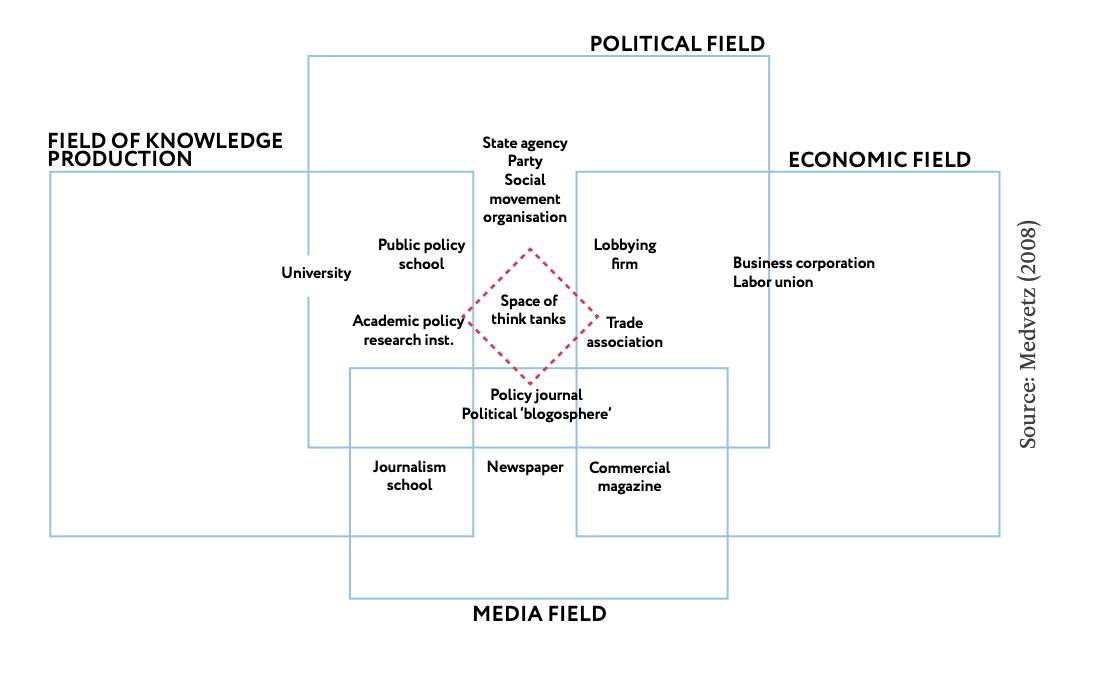
Others, like Anne-Marie Slaughter (2021) have argued that the ‘think tank’ concept is outdated, covering functions no longer reflective of this century. Today, think tanks are in the problem-solving space, developing responses to social, economic and political issues. Slaughter invites us to consider a new term that reflects these functions: the change hub. Unlike a closed-off tank, a hub connects diverse actors with the shared goal of initiating ideas and action to effect change.
Towards a definition
A strict and constraining definition of think tanks is of little use. Instead, it’s more practical to embrace a broad definition that recognises the diversity in forms, affiliations, ideologies, functions, and roles within think tanks.
With this perspective, think tanks can be described as diverse entities that have as their main objective to inform political actors (directly or indirectly) with the aim of facilitating policy change and achieving explicit policy outcomes. While their decisions rely on research-based evidence, they are still influenced by values. They may perform different functions, from shaping the public agenda to monitoring policy implementation and enhancing the capabilities of other policy actors. The nature of think tanks depends on their operational context; a think tank in China won’t mirror one in Bolivia, and we shouldn’t expect them to.
This short video explains that a think tank is an organisation that bridges research and policymaking by bringing evidence-based ideas into public debate. It highlights additional roles such as convening policy actors, building capacity among practitioners and communicators, and strengthening the legitimacy of policies by backing them with research.
Think tanks as a sector
The annual Think Tank State of the Sector reports, prepared by On Think Tanks and the Open Think Tank Directory— a publicly accessible repository of over 3,800 think tanks and policy-focused or boundary organisations—provides an overview of the sector. We encourage you to explore these resources to understand the sector’s growth and trends.
Would you like to add your think tank to the directory? Register it here.
References and further reading
- Abelson, D. (2009). Do Think Tanks Matter? Assessing the Impact of Public Policy Institutes. Montreal: McGill-Queen’s University Press.
- Balfour, R. (2017). What are think tanks for? policy research in the age of anti-expertise.
- McGann, J. and Johnson, E. (2005). Comparative Think Tanks, Politics and Public Policy. Cheltenham: Edward Elgar.
- Medvetz, T. (2012). ‘Murky Power: ‘Think Tanks’ as Boundary Organizations’, in David Courpasson, Damon Golsorkhi, Jeffrey J. Sallaz (ed.), Rethinking Power in Organizations, Institutions, and Markets (Research in the Sociology of Organizations, Volume 34), Emerald Group Publishing Limited, pp. 113–133.
- Mendizabal, E. (2010). On the definition of think tanks: Towards a more useful discussion.
- Mendizabal, E. (2010). On the business model and how this affects what think tanks do.
- Mendizabal, E. (2011). Different ways to define and describe think tanks.
- Mendizabal, E. (2011). Think tanks: research findings and some common challenges.
- Mendizabal, E. (2013). Think tanks in Latin America: what are they and what drives them?.
- Mendizabal, E. (2014). What is a think tank? Defining the boundaries of the label.
- Mendizabal, E. (2018). What’s New in our Understanding of how Evidence Influences Policy? A view from Latin America.
- Morestin, F. (2017). The advisors of policy makers: Who are they, how do they handle scientific knowledge and what can we learn about how to share such knowledge with them? Knowledge sharing and public policy series. Montréal and Québec, Canada: National Collaborating Centre for Healthy Public Policy
- On Think Tanks (n.d.). Open Think Tank Directory.
- On Think tanks- various authors (2015). Think Tanks and their context.
- Seele, A. (2013). What Should Think Tanks Do? A Strategic Guide to Policy Impact.
- Slaughter, A. (2021). From think tank to change hub.
- Stone, D. & Denham, A. (2004). Think tank traditions: Policy analysis across nations.
- Stone, D. (2001). ‘The policy research knowledge elite and global policy processes’, in Josselin, Daphné and Wallace (eds.), No-State Actors in World Politics. Palgrave Macmillan, pp. 113–132.
- Stone, D. (2005). Think Tanks and Policy Advice in Countries in Transition.
- Stone, D. (2007). ‘Recycling Bins, Garbage Cans or Think Tanks? Three Myths Regarding Policy Analysis Institutes’, Public Administration, 85(2): 259–278.